Treatment-timeline auto-generation
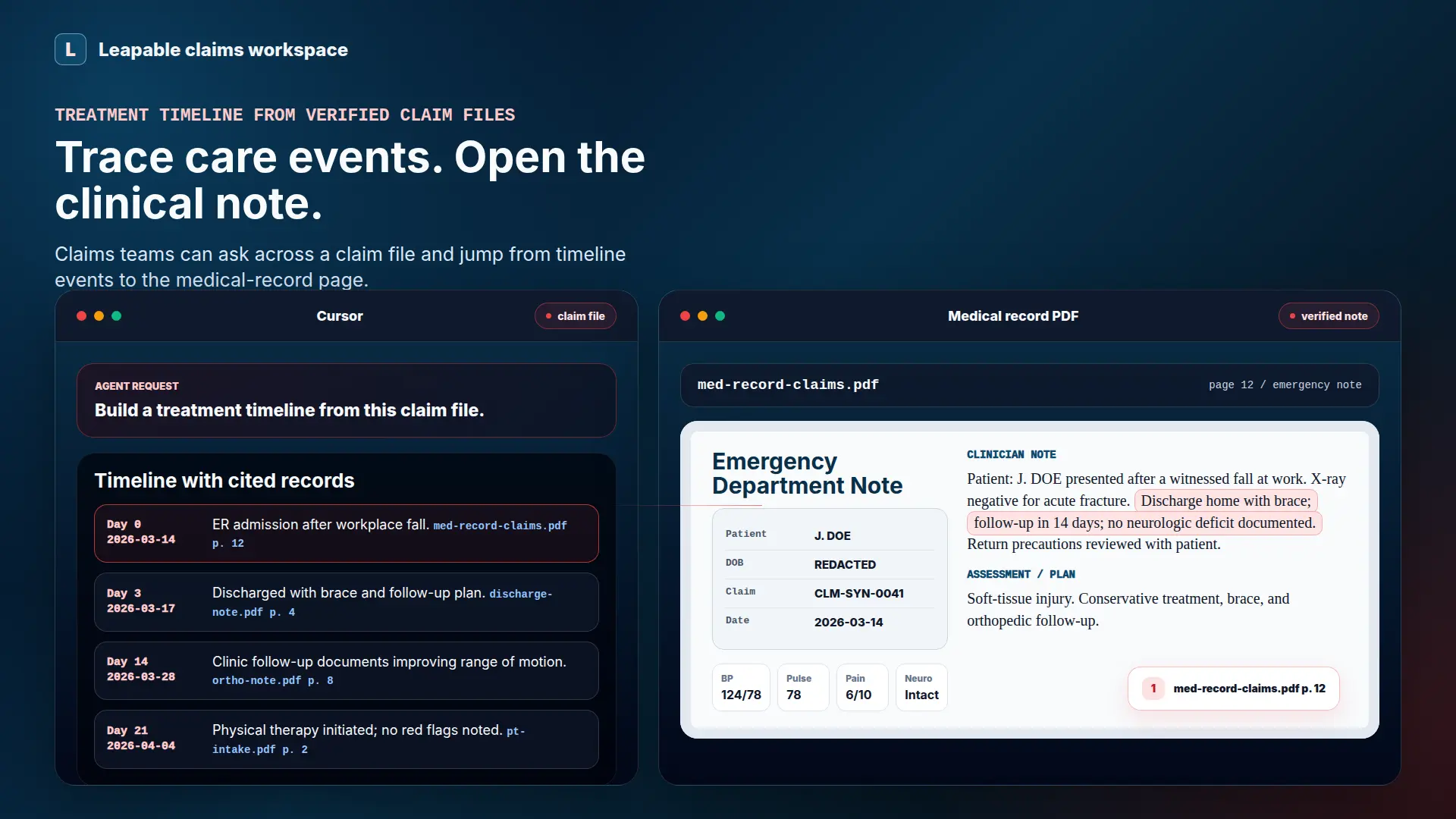
Extract dates, providers, complaints, procedures, gaps, and prior-history signals into a chronology with page references attached.
Claims review workspace
Drop a 200-page bodily injury claim file. Get a chronological treatment timeline in minutes. Every entry cites the medical record - page-level, click-to-verify.
Built for adjusters, SIU teams, nurse reviewers, defense counsel, and claims operations teams that need speed without losing the record.
How it works
Add the claim file, ask from your AI client, and inspect the exact page behind each treatment event, prior-history reference, demand allegation, or subpoena response.

The review backlog
Bodily injury review can span police reports, medical records, provider bills, demand letters, witness statements, photos, and prior-history files. The adjuster still has to build a defensible timeline across 30-160 documents per claim, catch contradictions, and answer before a 5-7 day adjuster queue grows. Leapable keeps that work tied to the source page instead of a detached summary.
60-second claim demo
Demo flow: add a bodily injury claim, ask for the treatment chronology, flag inconsistencies with prior medical history, and export an adjuster-ready summary with page references intact.
Input
Medical records, bills, demand letter, photos, reports.
Ask
Build a treatment timeline and show prior-history conflicts.
Output
Chronology, risk notes, source file, page, and quote.
Transcript pending until the claims review walkthrough is uploaded.
Capabilities
Extract dates, providers, complaints, procedures, gaps, and prior-history signals into a chronology with page references attached.
Group responsive records, cite the file and page, and preserve the review trail for defense counsel or compliance review.
Surface inconsistencies, repeated provider patterns, prior injuries, and cross-claim signals for human SIU review.
Keep PHI handling explicit: local vault control, scoped transient processing for OCR, no training, and reviewable audit records.
Typical workflows
01
Add the demand packet, summarize treatment, compare allegations to records, and keep source pages attached.
02
Group responsive materials, produce Bates-aware notes, and review every sensitive source before sharing.
03
Compare files for repeated providers, unusual dates, prior injuries, and contradiction clusters that merit escalation.
Competitor context
| Capability | Verisk Discovery Navigator | CLARA Claims DocIntel Pro | Persistent claims automation | Leapable |
|---|---|---|---|---|
| Primary fit | Medical record review and claim summaries | Casualty claims document intelligence | Service-led claims automation and IDP | Local-first claim file review across supported sources |
| Public pricing checked May 29, 2026 | Contact sales / sales representative flow | ROI calculator and free POC flow; no public seat price found | Service quote; no public product seat price found | Builder $49, Pro $99, Elite $2,000 |
| Local-first | No public local-first claim checked | No public local-first claim checked | No public local-first claim checked | Yes, local vault control for private files |
| MCP-native | Not advertised as MCP-native on official pages checked | Not advertised as MCP-native on official pages checked | Not advertised as MCP-native on official pages checked | Yes, 10 MCP client configurations and the registered MCP tool surface |
| HIPAA / regulated boundary | Built-in compliance and HIPAA standards language in product PDF | Secure claims platform language | Claims automation for regulated insurance workflows | HIPAA-ready architecture; not a certification claim |
Sources checked: Verisk Discovery Navigator and product PDF, CLARA Claims Document Intelligence Pro, Persistent claims automation, and HHS Security Rule guidance. HIPAA readiness depends on the customer workflow, agreements, and risk program.
Pricing
Builder supports a solo adjuster or small defense firm. Pro adds credits and API access for repeat team review. Elite covers high-volume insurer or legal-team rollout planning.
Trust and FAQ
It means the architecture supports regulated workflows with local vault control, explicit cloud-processing boundaries, no training, and audit records. It is not a certification or a substitute for a customer's own HIPAA program.
No. Leapable is a source-cited review workspace for claim files, medical records, demand letters, photos, and subpoenas. Your system of record remains the system of record.
Yes. Ask for chronology, prior-history references, treatment gaps, and cited support. Every entry keeps the source file and page reference attached.
Leapable supports 21 file types, including PDFs, Office docs, spreadsheets, images, CSV, Markdown, and text.
Final CTA
Install Leapable, add one claim folder, and ask for the timeline your team normally builds by hand.