Massive-scale document review
Handle TB-scale folders with PDFs, images, spreadsheets, presentations, CSV, Markdown, and text.
Investigations workspace
Drop a 2.6 TB document drop. Leapable indexes, OCRs, and surfaces every connection. Every answer cites the file, page, and entity.
Built for reporters, newsroom data teams, watchdogs, auditors, and consortium investigations that need defensible findings without assembling infrastructure first.
How it works
Add the drop, let OCR and extraction make it searchable, then ask from your AI client and inspect the cited file before a lead becomes a story sentence.

The legacy stack
ICIJ says the Panama Papers were 2.6 TB and 11.5 million leaked files, reviewed over a year by ICIJ, Suddeutsche Zeitung, and more than 100 media partners. Their technical writeups name Apache Solr, Blacklight, Apache Tika, Tesseract, Oxwall, and Linkurious as parts of the stack. You do not have time to be a sysadmin. You are on deadline.
Sources: ICIJ Panama Papers investigation facts and ICIJ data and technology stack.
60-second demo
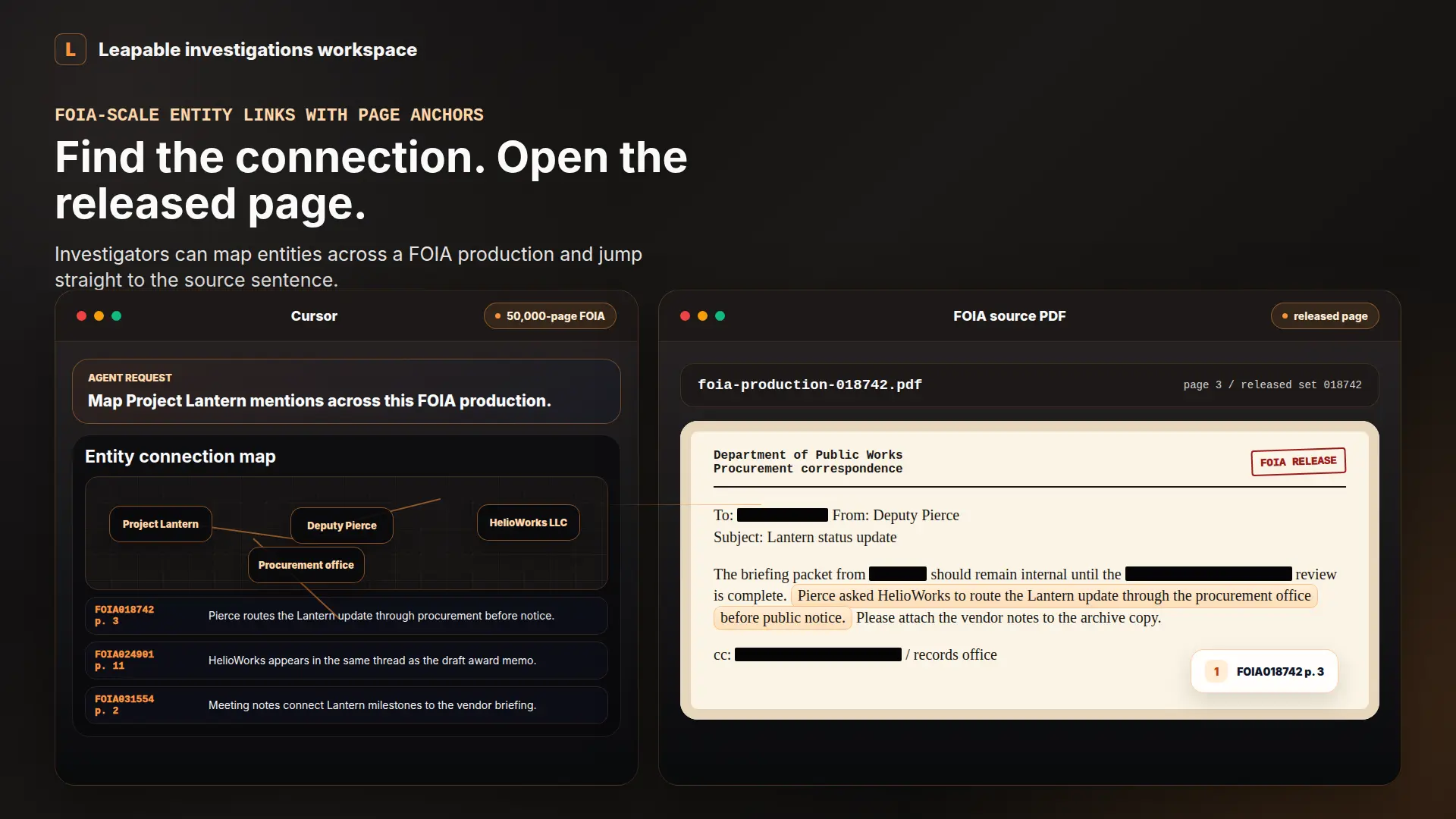
The reserved demo path is a scanned public-records production: OCR pages, find every mention of a target, compare redactions, and return cited findings your editor can inspect.
INPUT
Scanned FOIA files, spreadsheets, emails, and notes.
ASK
Find the target, aliases, companies, dates, and redaction patterns.
OUTPUT
Source-cited leads with file, page, and entity references.
Transcript placeholder: scanned production added to Leapable, OCR status completes, entity trail opens, and cited findings link back to source files.
Capabilities
Handle TB-scale folders with PDFs, images, spreadsheets, presentations, CSV, Markdown, and text.
Connect names, companies, addresses, dates, and recurring phrases across the drop.
Separate stories, sources, and legal-risk boundaries with local vault controls.
Roadmap work for matching entity trails across investigations without exposing full files.
Keep sensitive work local-first while preserving source hashes and cited outputs.
Move sealed vault files between trusted collaborators when a story needs distributed review.
Competitor reality
Investigation teams usually choose between custom open-source assembly, enterprise investigation platforms, and manual review. Leapable is the local-first MCP workspace between those extremes.
| Capability | Custom ICIJ-style stack | Enterprise investigation platform | Manual newsroom review | Leapable |
|---|---|---|---|---|
| Setup | Solr, Tika, Tesseract, Blacklight, Oxwall, Linkurious, glue code | Procurement and cloud onboarding | Folders, spreadsheets, and human memory | Install local workspace, add files, ask from MCP client |
| Local-first control | Depends on team architecture | Often cloud-first | Local but hard to verify | Yes, with explicit source citations |
| Entity trail | Powerful, if maintained | Varies by platform | Ad hoc | Cross-document entity extraction and cited findings |
| BYO LLM | Custom integration | Usually platform-defined | No | Yes, 10 MCP client configurations |
| Pricing posture | Engineer time plus hosting | Enterprise | Staff time | Explorer/free install, Builder $49, Pro $99, Elite $2,000 |
Casepoint and similar platforms serve government and enterprise investigations. This page is for teams that need a local-first source-cited workspace, not an enterprise cloud procurement project.
Pricing
Explorer starts free for independent review. Builder supports a newsroom subscription, Pro adds API access for an investigation team, and Elite supports consortium-scale work.
Trust and FAQ
ICIJ reports 11.5 million leaked files, 2.6 TB of data, and a year of work by ICIJ, Suddeutsche Zeitung, and more than 100 media partners.
Leapable gives smaller teams a local-first MCP workspace without assembling Solr, Tika, Tesseract, Blacklight, Oxwall, Linkurious, and custom glue first.
Add supported files, let OCR complete when needed, and inspect the cited source before a finding reaches an editor, lawyer, or partner.
Keep each investigation in its own vault, move sealed files between trusted collaborators, or talk to Leapable about a supported consortium workflow.
Final CTA
Install Leapable, add one FOIA folder, and ask the question your team has been postponing because the files are too scattered.